Thousands of children are at risk on the road because they are not buckled up.
Crashes remain a leading cause of death for children.
- Crash deaths have gone down in the past decade (43% drop), but still more than 650 children age 12 and under died in crashes in 2011.
- One in 3 children who died in crashes in 2011 was not buckled up.
Many factors are related to whether or not children are buckled up.
- Of the children who died in a crash:
- More black (45%) and Hispanic (46%) children were not buckled up compared with white (26%) children (2009-2010).
- More of the older children (45% of 8-12 year olds) were not buckled up compared with younger children (one-third of 1-7 year olds; one-fourth of infants under 1) in 2011.
Evidence shows that state laws result in more children being buckled up.
Only 2 states (Tennessee and Wyoming) have child passenger restraint laws requiring car seat or booster seat use for children age 8 and under.
Child passenger restraint laws that increase the age for car seat or booster seat use result in more children being buckled up. Among five states that increased the required car seat or booster seat age to 7 or 8 years, car seat and booster seat use tripled, and deaths and serious injuries decreased by 17%.

SOURCE: Insurance Institute for Highway Safety, 2013
Note: Only age was used to determine child passenger restraint law coverage. Some states also have specific height and/or weight requirements.
View larger image and text description

View larger image and text description
Using the correct car seat or booster seat can be a lifesaver: make sure your child is always buckled in an age- and size-appropriate car seat or booster seat.
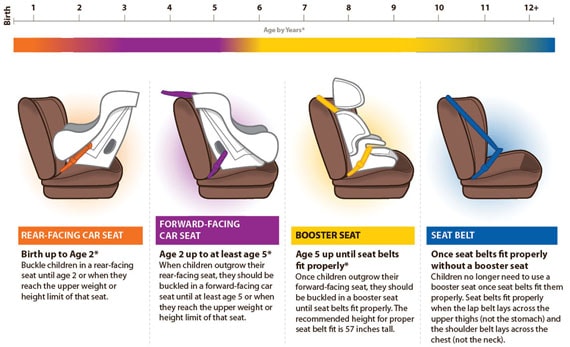
View larger image and text description
Keep children ages 12 and under in the back seat. Never place a rear-facing car seat in front of an active air bag.
Recommended age ranges for each seat type vary to account for differences in child growth and height/weight limits of car seats and booster seats.
Use the car seat or booster seat owner’s manual to check installation and the seat height/weight limits, and proper seat use..
Child safety seat recommendations: American Academy of Pediatrics.
Graphic design: adapted from National Highway Traffic Safety Administration.
Top of Page




 43%
43% 9,000
9,000 1 in 2