
 |
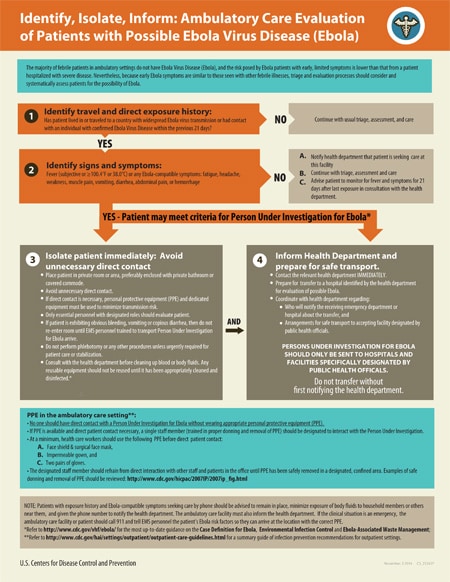
Outpatient and Ambulatory Care SettingsFor information on screening patients for Ebola, see FAQs on Screening for Ebola Virus Disease. For information on caring for survivors of Ebola, see Interim Guidance for Management of Survivors of Ebola Virus Disease in U.S. Healthcare Settings and Messages for the Care of Survivors of Ebola. Page SummaryWho this is for: Ambulatory care (outpatient) staff members. Ambulatory care settings can include community health centers, urgent care centers, retail clinics, hospital-based outpatient clinics, non-hospital based clinics and physician offices, ambulatory surgical centers, public health clinics, imaging centers, oncology clinics, ambulatory behavioral health and substance abuse clinics, physical therapy, rehabilitation centers, dental offices, school health clinics (college and other), home health care, and hospice (non-hospital) What this is for: Guidance to help ambulatory care staff members evaluate whether or not a patient might have Ebola virus disease (EVD). Staff members in ambulatory care settings should use this information to follow the 3 steps of the "Identify, Isolate, and Inform" strategy. CDC recommends staff members screen all patients with travel histories, exposure, or clinical symptoms that might suggest the person could have EVD. How this relates to other guidance: Given that people with a risk of exposure to Ebola virus are being closely monitored by state and local health departments and directed to designated facilities for evaluation should they become ill, it is unlikely that patients with EVD will arrive unannounced at an outpatient setting. If staff members do identify a patient with possible EVD, they should immediately isolate the patient and contact the local or state health department so the patient can be transported to a designated hospital. Key Points
Syndicated Content Details:
Source URL: http://www.cdc.gov/vhf/ebola/healthcare-us/outpatient-settings/index.html Source Agency: Centers for Disease Control and Prevention (CDC) Captured Date: 2016-05-23 22:53:55.0
|
|