
 |
CDC and Food SafetyFoodborne illness is a common, costly—yet preventable—public health problem. CDC estimates that 1 in 6 Americans get sick from contaminated foods or beverages and 3,000 die each year. The U.S. Department of Agriculture (USDA) estimates that foodborne illnesses cost $15.6 billion each year. The future of food safety depends on:
What Is CDC’s Role in Food Safety?Food safety depends on strong partnerships. CDC, the U.S. Food and Drug Administration (FDA), and USDA’s Food Safety and Inspection Service collaborate at the federal level to promote food safety. State and local health departments and food industries also play critical roles in all aspects of food safety. CDC provides the vital link between illness in people and the food safety systems of government agencies and food producers. 
CDC takes action by:
A Better Way to Find Outbreaks
Listeriosis linked to soft cheeses sickened 30 people and killed 3. CDC scientists have started using whole genome sequencing to show which bacterial strains are most alike genetically—which indicates those infections may have the same source. Whole genome sequencing provided a crucial clue during an investigation of a multistate Listeria outbreak linked to soft cheeses that killed three people and sickened 30. The traditional technique of DNA fingerprinting allowed scientists to identify five rare Listeria strains in the outbreak. Sequencing the bacteria provided even more detail about those five strains, showing that although they appeared to be quite different by the traditional technique, they were actually closely related genetically. With that clue, investigators knew to look for a single source for the outbreak, which led them to one dairy. They later learned that the dairy had a long-standing issue with Listeria contamination in its manufacturing facility. Challenges to America’s Food SafetyChanges in the Food Supply and New Sources of IllnessesSometimes foods we love to eat and rely on for good health are contaminated with bacteria that cause illness and can be deadly for certain people. More progress is needed to protect people and reduce foodborne illnesses in America. Challenges to food safety will continue to arise in unpredictable ways, largely due to:
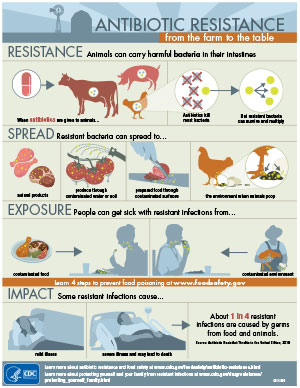
The Threat of Antibiotic ResistanceAntibiotic resistance in foodborne bacteria is a growing food safety challenge that is made worse by overuse of antibiotics in humans and food animals. CDC estimates that every year, over 400,000 people in the United States are sickened with resistant Salmonella or Campylobacter. The National Antimicrobial Resistance Monitoring System (NARMS), a partnership of CDC, FDA, and USDA, will play an expanded role under the National Strategy for Combating Antibiotic-Resistant Bacteria (CARB) [PDF – 37 pages] by:
Learn More
Syndicated Content Details:
Source URL: http://www.cdc.gov/foodsafety/cdc-and-food-safety.html Source Agency: Centers for Disease Control and Prevention (CDC) Captured Date: 2016-05-23 23:12:51.0
|


|