CDC’s Emergency Operations Center (EOC) is home to hundreds of CDC staff working in collaboration with local, national, and international response partners to analyze, validate, and efficiently exchange information about the Zika outbreak.
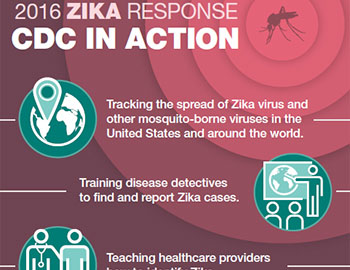
The EOC is the command center for monitoring and coordinating the emergency response to Zika, bringing together CDC scientists with expertise in arboviruses like Zika, reproductive health, birth defects, and developmental disabilities, and travel health. Their work includes:
On January 22, 2016, CDC activated its Emergency Operations Center (EOC) to respond to outbreaks of Zika occurring in the Americas and increased reports of birth defects and Guillain-Barré syndrome in areas affected by Zika. On February 8, 2016, CDC elevated its EOC activation to a Level 1, the highest level.
On February 1, 2016, the World Health Organization declared a Public Health Emergency of International Concern (PHEIC) because of clusters of microcephaly and other neurological disorders in some areas affected by Zika.
On February 8, 2016, President Obama announced a request for $1.8 billion in emergency funds for several agencies to accelerate research into a vaccine and educate populations at risk for disease.
On September 29, 2016, President Obama signed a continuing resolution that provides $1.1 billion in emergency funding for Zika response.
On November 18, 2016, WHO declared the end of the PHEIC after deciding that Zika virus and its associated consequences remain a significant enduring public health challenge requiring intense action, but no longer represent a PHEIC.
On September 29, 2017, CDC deactivated its response to Zika. Although CDC has deactivated its response, CDC’s Zika experts and key personnel will continue working on Zika-related activities.