According to this week’s FluView report, seasonal influenza activity remains low overall in the United States. However, 4 states and Guam reported regional flu activity and 12 states and Puerto Rico reported local influenza activity. Flu vaccine is the best available way to protect against influenza. CDC recommends that everyone 6 months and older get an injectable flu vaccine as soon as possible. Below is a summary of the key flu indicators for the week ending October 28, 2017:
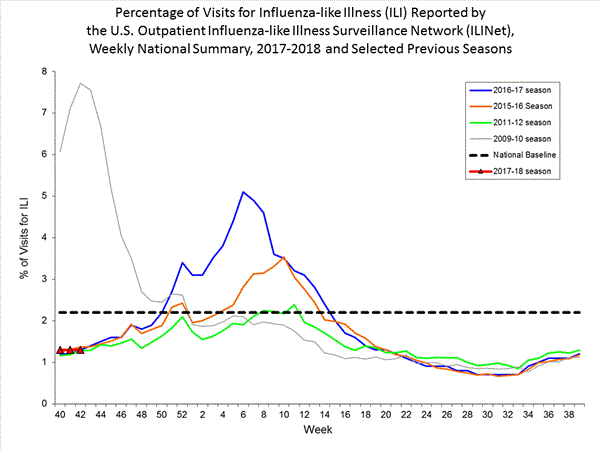
Influenza-like Illness Surveillance: For the week ending October 28, the proportion of people seeing their health care provider for influenza-like illness (ILI) was 1.5% and is below the national baseline of 2.2%. All 10 regions reported a proportion of outpatient visits for ILI below their region-specific baseline levels.
Influenza-like Illness State Activity Indicator Map: One state experienced moderate ILI activity (Wyoming). Four states (Georgia, Louisiana, South Carolina, and South Dakota) experienced low ILI activity. New York City and 45 states experienced minimal ILI activity. Data were insufficient to calculate an ILI activity level from the District of Columbia and Puerto Rico.
Geographic Spread of Influenza Viruses: Regional influenza activity was reported by Guam and four states (Georgia, Louisiana, Oklahoma, and Texas). Local influenza activity was reported by Puerto Rico and 12 states (Alaska, Arizona, California, Connecticut, Kentucky, Maine, Massachusetts, Mississippi, New Mexico, Ohio, South Carolina, and Tennessee). Sporadic activity was reported by the District of Columbia and 31 states (Alabama, Arkansas, Colorado, Delaware, Florida, Hawaii, Idaho, Indiana, Illinois, Iowa, Kansas, Maryland, Michigan, Minnesota, Missouri, Montana, Nebraska, Nevada, New Jersey, New York, North Carolina, North Dakota, Oregon, Pennsylvania, South Dakota, Utah, Vermont, Virginia, Washington, Wisconsin, and Wyoming). No activity was reported by one state (Rhode Island). The U.S. Virgin Islands and two states (New Hampshire and West Virginia) did not report. Geographic spread data show how many areas within a state or territory are seeing flu activity.
Flu-Associated Hospitalizations: Reporting of influenza-associated hospitalization data from the Influenza Hospitalization Surveillance Network (FluSurv-NET) for the 2017-2018 influenza season will begin later this season.
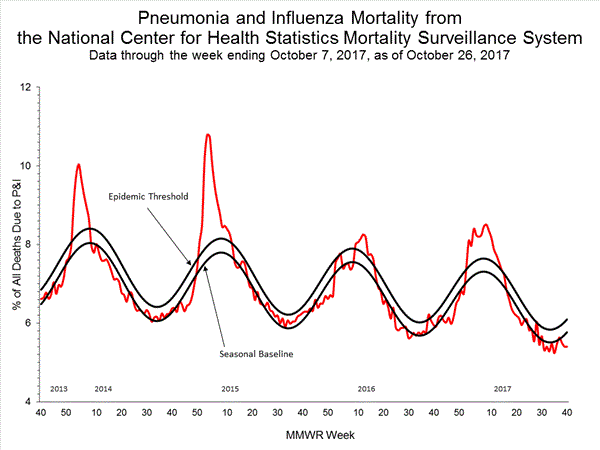
The proportion of deaths attributed to pneumonia and influenza (P&I) was 5.6% for the week ending October 14, 2017 (week 41). This percentage is below the epidemic threshold of 6.2% for week 41 in the National Center for Health Statistics (NCHS) Mortality Surveillance System.
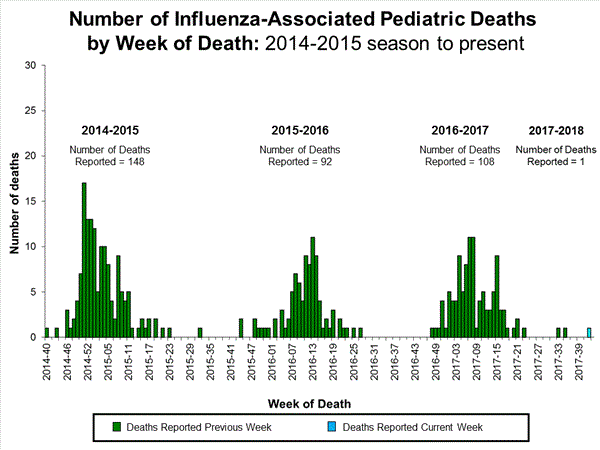
One influenza-associated pediatric death that occurred during the 2016-2017 flu season was reported to CDC during the week ending October 28, 2017 (week 43).
This death was associated with an influenza A (H3) virus and occurred during week 7 (the week ending February 18, 2017). This death brings the total number of reported influenza-associated pediatric deaths occurring during 2016-2017 season to 109.
One influenza-associated pediatric death for the 2017-2018 season has been reported to CDC.
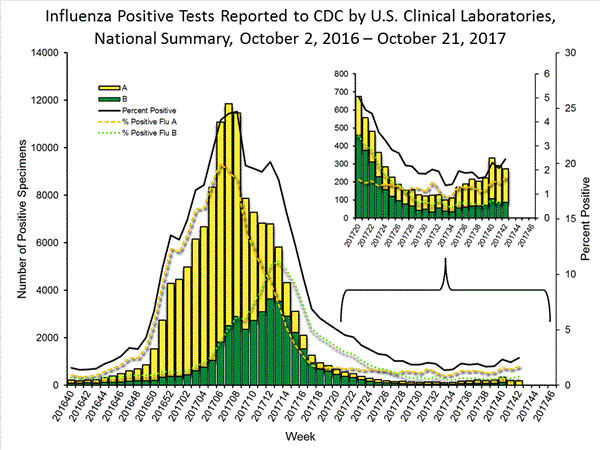
Nationally, the percentage of respiratory specimens testing positive for influenza viruses in clinical laboratories during the week ending October 28 was 2.9%.
Regionally, the three week average percent of specimens testing positive for influenza in clinical laboratories ranged from 0.4% to 5.7%.
During the week ending October 28, of the 336 (9%) influenza-positive tests reported to CDC by clinical laboratories, 228 (67.9%) were influenza A viruses and 108 (32.1%) were influenza B viruses.
The most frequently identified influenza virus type reported by public health laboratories was influenza A virus.
During the week ending October 28, 336 (2.9%) of the 119 influenza-positive tests reported to CDC by public health laboratories were influenza A viruses and 10 (8.4%) were influenza B viruses. Of the 102 influenza A viruses that were subtyped, 88 (86.3%) were H3N2 viruses and 14 (13.7%) were (H1N1)pdm09 viruses.
The majority of the influenza viruses collected from the United States during May 21 through October 28, 2017 were characterized antigenically and genetically as being similar to the cell-grown reference viruses representing the 2017–18 Northern Hemisphere influenza vaccine viruses.
None of the viruses tested from May 21-October 28, 2017 were found to be resistant to oseltamivir, zanamivir, or peramivir.
Three human infections with novel influenza A viruses were reported by 3 states (Colorado [1], Nebraska [1], and Michigan [1]) during the week ending October 28. Two infections were with influenza A(H3N2) variant (H3N2v) viruses and one infection was with an influenza A(H1N2) variant (H1N2v) virus. No ongoing human-to-human transmission was identified.
FluView is available – and past issues are archived – on the CDC website.
Note: Delays in reporting may mean that data changes over time. The most up to date data for all weeks during the 2017-2018 season can be found on the current FluView and FluView Interactive.