The agency’s mission to protect public health was supported by communications founded on emergency risk communications principles of quickly, proactively and transparently communicating accurate information about the situation
This included clearly stating CDC’s goals and actions in response to the evolving situation and acknowledging what was not known as well as what was known. The goal was to inform the public, but to avoid causing unnecessary fear
From the earliest days of the pandemic, CDC clearly and repeatedly stated its goals to “reduce transmission and illness severity, and to provide information to help health care providers, public health officials and the public address the challenges posed by the new virus.” Communications messages were tempered by the values – Be first, be right, and be credible
CDC quickly disseminated information to support those stated goals and dozens of communications tools were used to reach out to audiences across the spectrum, from the public to pharmacists to diagnostics experts to international partners and countries around the globe
During the early days of the outbreak especially, the release and exchange of information was conducted on a 24-hour cycle and included frequent updates to media and the public, as well as the consistent use of a body of core spokespersons, daily information outreach to partners, and rapid establishment and daily maintenance of extensive Web content related to the emergency response
Outlets for outreach included the media, the Internet, health alert networks, outreach through partners and partner organizations, and a 24-hour information hotline, called CDC-INFO
Throughout the pandemic, CDC-INFO responded to over 212,368 inquiries about 2009 H1N1, including 141,775 general public phone calls, 47,311 general public emails, 23,268 clinician phone calls, and 13 letters
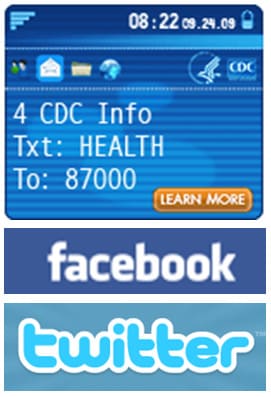
New methods of outreach were utilized, including video Podcasts, YouTube videos, Facebook postings and Twitter to reach out to people using new and emergent technologies
CDC obtained 55,341 Facebook fans during the pandemic
CDC also shared 2009 H1N1 health information through three Twitter feeds: CDCFlu, CDCEmergency, and CDC_ehealth
There are 1,248,719 Twitter followers for the CDC emergency profile, 33,920 Twitter followers for the CDC_eHealth profile, and 31,338 Twitter followers for the CDCFlu profile
Video Podcasts and YouTube videos featuring CDC Influenza Division subject matter experts received millions of hits and brought the American public and the rest of the world closer to the science of flu and public health than ever before
2,991,280 Podcasts related to 2009 H1N1 were downloaded
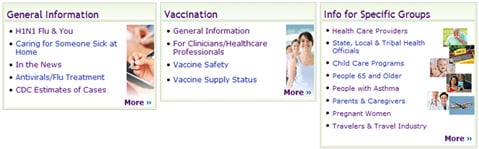
CDC’s 2009 H1N1 influenza website grew from one page to over 200 pages in the first three weeks of the 2009 H1N1 outbreak. The website had received more than 221,388,322 page views since its creation
Key materials and Web pages were translated into multiple languages. For example, the entire English-language 2009 H1N1 site was mirrored in Spanish. In addition, key tools and resources were created in Chinese, Vietnamese, Korean, Japanese, French, German, Arabic, Russian, Amharic, Farsi, Somali, Karen, Burmese, Cambodian and Kirundi
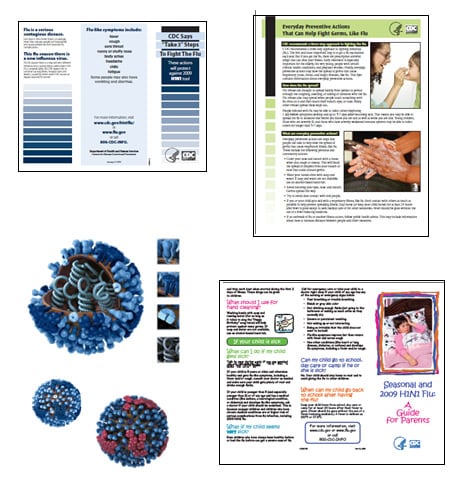
2009 H1N1 related factsheets, flyers and brochures were designed, created and made available throughout the pandemic to different audiences on CDC’s free flu resources webpage (www.cdc.gov/h1n1flu/freeresources.htm)
In addition, new images of the virus were created and posted on the “Images of the H1N1 influenza virus” page www.cdc.gov/h1n1flu/images.htm
Key messages were developed internally and distributed daily, and later, weekly, to states, partners and affiliates throughout the outbreak response. The first key messages were distributed on April 19, 2009
CDC’s Division of Global Migration and Quarantine managed and implemented a national Travelers’ Health media campaign with messages for healthy travel posted and distributed in over 300 ports of entry to the United States, plus national radio, newspaper and online advertisements with over 80 million exposures