
 |
|
Content on this page was developed during the 2009-2010 H1N1 pandemic and has not been updated.
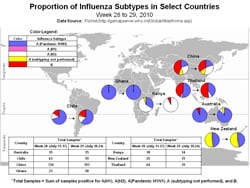
2009 H1N1 Flu: International Situation UpdateAugust 9, 2010, 4:00 PM ET This report provides an update to the international flu situation using data collected through August 1, 2010, and reported by the World Health Organization (WHO) on August 6. Global Flu Activity UpdateWHO continues to report laboratory-confirmed 2009 H1N1 flu deaths and situational updates on its Web page. These fatal cases are an under-representation of the actual numbers, as many deaths are never tested for influenza or recognized as flu related. Overall, flu activity due to 2009 H1N1 and seasonal influenza viruses is low worldwide. Northern TemperateIn the Northern Hemisphere, flu activity has been low or sporadic during the past month. Southern TemperateIn the Southern Hemisphere, levels of flu activity vary by location with the most active areas of pandemic transmission in parts of South Asia and in limited areas of tropical and South America. Overall seasonal and pandemic flu activity remains low in the temperate zone of the Southern Hemisphere, except in South Africa. East Africa and Southeast Asia continue to see circulation of seasonal influenza viruses, especially influenza A (H3N2). Australia and New Zealand have reported increases in influenza like activity (ILI) rates for the past 6-8 weeks, particularly in recent weeks; however, rates are still below those seen in 2009. 2009 H1N1 is the most frequently reported influenza virus, with low level co-circulation of influenza A (H3N2) and influenza B viruses. Argentina and Chile are reporting overall low flu activity. 2009 H1N1 is the most frequently reported influenza virus in Chile, with low level co-circulation of influenza B and A (H3N2). Tropical and subtropicalLatin AmericaCentral America continues to report circulation of seasonal influenza viruses, especially influenza A (H3N2). AsiaIn Asia, the most active areas of influenza transmission are occurring in parts of India, predominantly 2009 H1N1? Any seasonal?. However, preliminary data suggests that the overall intensity and severity is lower than that observed during the first waves of 2009. Low levels of 2009 H1N1 activity are also being detected in several Southeast Asia countries, including Nepal and Bhutan. AfricaVirologic data from South Africa suggests flu activity peaked in early July, mostly due to seasonal influenza B and A (H3N2) viruses. Sustained transmission of 2009 H1N1 was reported in Ghana during June and July 2010. In parts of Eastern Africa and Central Africa, data suggest that seasonal influenza A (H3N2) and B viruses continue to circulate. Low level circulation of influenza A (H3N2) has been reported in Kenya, and Cameroon has recently reported subsiding levels of influenza B. Selected Highlights
Health Organizations
World Health Organization (WHO) Regional Offices
Travel and 2009 H1N1 FluHuman cases of 2009 H1N1 flu virus infection have been identified in the United States and several countries around the world. For information on 2009 H1N1 flu and travel, see the CDC H1N1 Flu and Travel website. Reports and Publications
Syndicated Content Details:
Source URL: http://www.cdc.gov/h1n1flu/updates/international/index.htm Source Agency: Centers for Disease Control and Prevention (CDC) Captured Date: 2012-06-27 18:39:01.0
|
|