
 |
How Duchenne/Becker Muscular Dystrophy is Inherited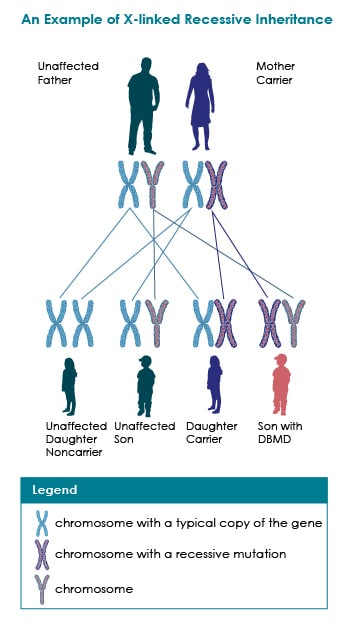
The change in the gene that causes Duchenne/Becker muscular dystrophy (DBMD) happens on the X chromosome. A boy gets an X chromosome from his mother and a Y chromosome from his father. Only the X chromosome can have the changed gene that causes DBMD. Females almost never have DBMD because they have two X chromosomes. Even if a female has one X chromosome with the DBMD gene, her second X chromosome usually will make enough dystrophin to keep her muscles strong. Because a female can carry (or have) one DBMD mutation and not be affected, she is referred to as a carrier. As a carrier, a female does have a risk of passing the same mutation on to her children. Each son born to a carrier female has a 50% chance of inheriting the DBMD mutation and having MD. Each daughter born to a carrier female instead has a 50% chance of inheriting the DBMD mutation and becoming a carrier like her mother. Although most males diagnosed with DBMD are known to have inherited the mutation from their mothers, about one-third of cases are the result of a new mutation in which the mother is not a carrier. Rather, the new mutation happened randomly in the fertilized egg. In these cases, it is unlikely that other children of that same couple will be affected similarly by DBMD.
Syndicated Content Details:
Source URL: http://www.cdc.gov/ncbddd/musculardystrophy/inheritance.html Source Agency: Centers for Disease Control and Prevention (CDC) Captured Date: 2016-05-23 22:12:35.0
|
|