
 |
|
Persons using assistive technology might not be able to fully access information in this file. For assistance, please send e-mail to: mmwrq@cdc.gov. Type 508 Accommodation and the title of the report in the subject line of e-mail. Geographic Differences in HIV Infection Among Hispanics or Latinos — 46 States and Puerto Rico, 2010In the United States, Hispanics or Latinos are disproportionately affected by infection with human immunodeficiency virus (HIV). In 2010, new diagnoses of HIV infection among Hispanics or Latinos occurred at an annual rate that was 2.8 times that of non-Hispanic whites (20.4 versus 7.3 per 100,000 persons) (1). To further assess HIV infection among Hispanics or Latinos in the United States, CDC analyzed the geographic distribution of new diagnoses in 2010 in 46 states and Puerto Rico and the characteristics of those diagnosed. The results of this analysis determined that a lower percentage of infections were attributed to male-to-male sexual contact in Puerto Rico than in the 46 states (36.1% versus 66.5%) and a higher percentage were attributed to heterosexual contact (40.7% versus 22.0%) or injection-drug use (IDU) (20.4% versus 8.6%). In the 46 states, the rate of new diagnoses of HIV infection among Hispanics or Latinos in the Northeast Census region in 2010 (55.0 per 100,000 persons) was more than twice as high as in other regions, and a higher percentage of those with a new HIV diagnosis were born in Puerto Rico or had their HIV infection attributed to IDU, compared with other regions. Geographic differences in HIV infection among Hispanics or Latinos should be addressed with HIV testing, prevention, and treatment efforts tailored to specific communities. Data were analyzed for Hispanics or Latinos* with newly diagnosed HIV infection in 2010 who were aged =13 years at HIV diagnosis and for those living with a diagnosis of HIV infection who were aged =13 years at the end of 2009. The data were reported to CDC through June 2011 by Puerto Rico, which represented 98.1% of Hispanics or Latinos diagnosed with HIV infection in five U.S. dependent areas† in 2010, and the 46 states. All of these reporting areas have had confidential, name-based HIV infection reporting since at least January 2007. The numbers and percentages of HIV diagnoses in 2010 among Hispanic or Latino adolescents and adults in each U.S. Census region§ and Puerto Rico were calculated by sex, age group, transmission category, residence at diagnosis, and place of birth. The number of diagnoses of HIV infection was adjusted for reporting delay but not for incomplete reporting. Multiple imputation was used to assign a transmission category to those cases missing risk information (2,3). The number of persons living with a diagnosis of HIV infection (prevalence of diagnosed HIV infection) was further adjusted to account for the delay in reporting of deaths among persons with HIV. Where possible, rates per 100,000 persons were calculated based on postcensal estimates of Hispanic populations from the U.S. Census Bureau (4). New Diagnoses of HIV Infection In 2010, an estimated total of 10,731 Hispanics or Latinos were newly diagnosed with HIV infection in 46 states (9,620 [89.6%]) and Puerto Rico (1,111 [10.4%]) (Table 1). By category, 83.2% were males, 63.4% were men who had sex with men, and 86.4% were urban residents; infection was most common (32.4%) among persons aged 25–34 years. Among the 8,966 (83.6%) cases with birthplace data available, 54.4% of new diagnoses were in persons born outside of the 50 states and the District of Columbia; the highest percentages were from Mexico (19.4%) and Puerto Rico (15.8%). Compared with new diagnoses of HIV infection among Hispanics or Latinos in the 46 states, lower percentages of diagnoses in Hispanics or Latinos in Puerto Rico were among males (75.3% versus 84.1%), men who had sex with men (36.1% versus 66.5%), and urban residents¶ (69.8% versus 88.3%); higher percentages were among those aged =45 years (35.5% versus 22.0%) or with a diagnosis attributed to heterosexual contact (40.7% versus 22.0%) or IDU (20.4% versus 8.6%). Among the 46 states, a higher percentage of Hispanics or Latinos with new diagnoses resided in the South (35.4%), followed by the West (32.1%), Northeast (26.3%), and Midwest (6.2%). Characteristics of Hispanics or Latinos with a new diagnosis of HIV infection in 2010 differed regionally. Compared with other regions, the Northeast had the lowest percentage of diagnoses in males (76.7%) and in rural residents** (1.3%), whereas the South had the highest percentage in rural residents (6.0%). Although male-to-male sexual contact was the predominant transmission category for HIV infection overall (66.5%), a lower percentage of HIV infections were attributed to male-to-male sexual contact in the Northeast (52.5%). More infections were attributed to IDU in the Northeast than elsewhere (15.8% versus <8.8% in the other regions). In 2010, 48.7% of the Hispanics or Latinos in the 46 states with a diagnosis of HIV infection attributed to IDU lived in the Northeast. Among Hispanics or Latinos with new diagnoses of HIV infection who were born outside of the 50 states and the District of Columbia, Puerto Rico was the most common birthplace in the Northeast (10.6%) and Mexico in all other regions (>18.6%). In 2010, the overall rate of new diagnoses of HIV infection among Hispanics or Latinos in 46 states was 27.6 per 100,000 persons. The rate in the Northeast (55.0) was more than twice that of any other region (Table 2). Prevalence Rate of Diagnosed HIV Infection At the end of 2009, the overall prevalence rate of diagnosed HIV infection among Hispanics or Latinos was 432.3 per 100,000 persons. The prevalence rate of diagnosed HIV infection in the Northeast (1,252.6) was 3.8 times that in the South, the region with the next highest rate (333.7). Four of the five states with the highest prevalence rates of diagnosed HIV infection per 100,000 Hispanics or Latinos at the end of 2009 were in the Northeast (Figure). Reported byQian An, MS, Angela Hernandez, MD, Joseph Prejean, PhD, Emilio J. German, MS, Horace Thompson, H. Irene Hall, PhD, Div of HIV/AIDS Prevention, National Center for HIV/AIDS, Viral Hepatitis, STD, and TB Prevention, CDC. Corresponding contributor: Qian An, qan@cdc.gov, 404-639-8523. Editorial NoteThe burden of HIV infection among Hispanics or Latinos differs between the 46 states and Puerto Rico. In 2010, Hispanics or Latinos with new diagnoses of HIV infection in Puerto Rico were more likely to have HIV infection attributed to IDU or heterosexual contact and were older than those with new diagnoses in the 46 states. Within the 46 states, the Northeast region accounted for an estimated 13.9% of the Hispanic or Latino population in 2010 (5) but 26.3% of new diagnoses of HIV infection. During the study period, the highest rate of new diagnoses of HIV infection and the highest prevalence rate of diagnosed HIV infection in Hispanics or Latinos were in the Northeast. The disproportionately high percentage of Hispanics or Latinos living with a diagnosis of HIV infection might pose a greater risk for HIV transmission for Hispanics or Latinos in the Northeast than in other regions (6). Unlike the South and West regions, where Hispanics or Latinos tend to be of Mexican and Central American descent, 34.9% of Hispanics or Latinos in the Northeast are of Puerto Rican origin (5). Hispanics or Latinos in the Northeast are more likely to acquire HIV infection through IDU than Hispanics or Latinos in other regions, which might, in part, reflect an influence of the epidemiology of HIV transmission in Puerto Rico (7). The South region had the second highest rate of new HIV diagnoses among Hispanics or Latinos. In the past 10 years, the South has experienced the largest percentage growth in the Hispanic or Latino population, possibly as a result of increased migration (5). Hispanic or Latino migrants in this region tend to be young, unaccompanied males. Studies have suggested that this population might be entering social surroundings with increased risks for HIV infection in their new environment (8). The findings in this report are subject to at least three limitations. First, results are based on data from 46 states and Puerto Rico. However, these areas represent approximately 91.2% of reported acquired immunodeficiency syndrome (AIDS) diagnoses in the United States and the dependent areas, and states with high proportions of Hispanics or Latinos were included. Second, data were adjusted for reporting delay but not incomplete reporting, and statistical adjustment of data might have introduced uncertainties into estimates of diagnoses of HIV infections or of the number of persons living with a diagnosis of HIV infection. Finally, birthplace data were missing for 16.4% of Hispanics or Latinos newly diagnosed with HIV infection in 2010. Additionally, birthplace does not indicate where a person became HIV infected. The National HIV/AIDS Strategy calls for intensified HIV prevention efforts in communities where HIV infection is most heavily concentrated, including Hispanic or Latino communities (9). The findings in this report suggest that HIV intervention efforts should be tailored to the characteristics and needs of the Hispanic or Latino population in different geographic areas. Regionally specific HIV prevention efforts should be used to increase early diagnosis and linkage to care for Hispanics or Latinos. CDC's high-impact prevention approach, a combination of scientifically proven, cost-effective, and scalable interventions (e.g., biomedical interventions, HIV testing and linkage to care, and individual and small group interventions), could be used in high-risk Hispanic or Latino populations, particularly injection-drug users in the Northeast and Puerto Rico, persons in rural areas, and recent immigrants to the South. AcknowledgmentSandra Miranda De Leon, MPH, HIV Surveillance Program, Puerto Rico Dept of Health. References
* Hispanics or Latinos might be of any race. † The five U.S. dependent areas are American Samoa, Guam, the Northern Mariana Islands, Puerto Rico, and the U.S. Virgin Islands. § Northeast: Connecticut, Maine, New Hampshire, New Jersey, New York, Pennsylvania, and Rhode Island; Midwest: Illinois, Indiana, Iowa, Kansas, Michigan, Minnesota, Missouri, Nebraska, North Dakota, Ohio, South Dakota, and Wisconsin; South: Alabama, Arkansas, Delaware, Florida, Georgia, Kentucky, Louisiana, Mississippi, North Carolina, Oklahoma, South Carolina, Tennessee, Texas, Virginia, and West Virginia; West: Alaska, Arizona, California, Colorado, Idaho, Montana, Nevada, New Mexico, Oregon, Utah, Washington, and Wyoming. ¶ Residents of metropolitan areas with =500,000 population. ** Residents of nonmetropolitan areas with <50,000 population. What is already known on this topic? In the United States, Hispanics or Latinos are disproportionately affected by human immunodeficiency virus (HIV) infection. For example, in 2010, new diagnoses of HIV infection among Hispanics or Latinos occurred at an annual rate that was 2.8 times that of non-Hispanic whites. What is added by this report? In 2010, Hispanics or Latinos with a new diagnosis of HIV infection in the Northeast and Puerto Rico were more likely to have HIV infection attributed to injection-drug use than in other regions. Within the 46 states, the Northeast region had the highest rate of new HIV diagnoses among Hispanics or Latinos in 2010 and the highest prevalence rate of diagnosed HIV infection at the end of 2009. What are the implications for public health practice? HIV interventions should be tailored to the differing needs of populations in different geographic areas. Regionally specific HIV prevention efforts should be used to increase early diagnosis and linkage to care for Hispanics or Latinos. CDC's high-impact prevention approach could be used in high-risk Hispanic or Latino populations, particularly injection-drug users in the Northeast and Puerto Rico, those in rural areas, and recent immigrants to the South. FIGURE. Estimated prevalence rate* of diagnosed HIV infection among Hispanics or Latinos† aged =13 years at the end of 2009 — 46 states 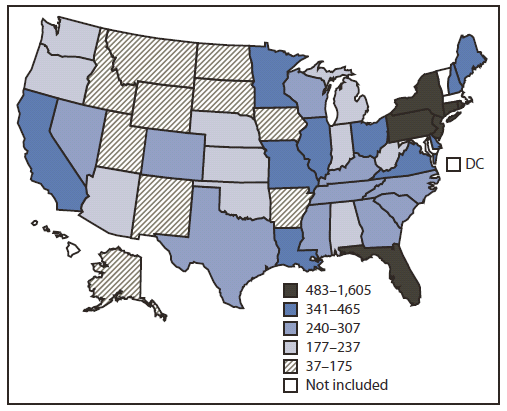
* Per 100,000 persons. Estimates resulted from statistical adjustment that accounted for reporting delay and missing risk-factor information, but not for incomplete reporting. † Hispanics or Latinos might be of any race. Alternate Text: The figure above shows the estimated prevalence rate of diagnosed HIV infection among Hispanics or Latinos aged =13 years in 46 states during 2009. At the end of 2009, the overall prevalence rate of diagnosed HIV infection among Hispanics or Latinos was 432.3 per 100,000 persons. The prevalence rate of diagnosed HIV infection in the Northeast (1,252.6) was 3.8 times that in the South, the region with the next highest rate (333.7). Four of the five states with the highest prevalence rates of diagnosed HIV infection per 100,000 Hispanics or Latinos at the end of 2009 were in the Northeast. Syndicated Content Details:
Source URL: http://www.cdc.gov/mmwr/preview/mmwrhtml/mm6140a2.htm Source Agency: Centers for Disease Control and Prevention (CDC) Captured Date: 2016-05-23 22:14:16.0
|
|