
 |
|
Persons using assistive technology might not be able to fully access information in this file. For assistance, please send e-mail to: mmwrq@cdc.gov. Type 508 Accommodation and the title of the report in the subject line of e-mail. Years of Potential Life Lost from Unintentional Injuries Among Persons Aged 0–19 Years — United States, 2000–2009Unintentional injuries are the leading cause of deaths among persons aged 0–19 years in the United States. Quantifying years of potential life lost (YPLL) highlights childhood causes of mortality and provides a simple method to identify important causes of premature death and specific groups in need of intervention (1). Deaths attributed to unintentional injuries among persons aged 0–19 years number approximately 12,000 each year in the United States; another 9 million young persons are treated for nonfatal injuries in emergency departments (2). To estimate the burden of premature deaths attributed to unintentional injuries among persons aged 0–19 years, CDC calculated state-specific YPLL by sex, age, race, and injury mechanism based on data from the National Vital Statistics System multiple cause of death files for the period 2000–2009. This report summarizes the results of that analysis, which found that an average of 890 years of potential life were lost each year because of unintentional injuries for every 100,000 persons aged 0–19 years. The burden of unintentional injuries was higher among males compared with females, among persons aged <1 year and those aged 15–19 years compared with the other 5-year age groups, among American Indian/Alaska Native (AI/AN) compared with those of any other race/ethnicity, and among those residing in two clusters of adjacent states (the South Central states of Arkansas, Louisiana, Mississippi, and Alabama, and the Mountain states of Montana, Wyoming, and South Dakota) compared with any other region. These estimates can be used to target injury prevention strategies to young persons most at risk. CDC analyzed data from the National Vital Statistics System multiple cause of death files for the period 2000–2009 (3), the most recent data available. Unintentional injury deaths were defined as those with the underlying cause of death classified by the International Classification of Diseases, 10th Revision (ICD-10) as drowning (W65–W74), falls (W00–W19), fires or burns (X00–X19), transport-related injuries (V01–V99), poisoning (X40–X49), and suffocation (W75–W84) (4), or falling in a category of other injury deaths comprising all other mechanisms of unintentional injuries: cut or pierced, unintentional firearm, machinery, natural and environmental, overexertion, struck by or against an object, and other specified and unspecified. YPLL was calculated for each decedent by subtracting the age at death in years from 75. Annualized YPLL during 2000–2009 for each demographic group, injury mechanism, and geographic area was calculated by summing its associated YPLL for the 10 years and dividing by 10. The annualized YPLL per 100,000 for each demographic group, injury mechanism, or geographic area was calculated by dividing its YPLL for 2000–2009 by the sum of the mid-year annual population estimates of the relevant population for 2000–2009. Population estimates used for YPLL rate calculations were bridged-race population figures (5). Annualized YPLL and YPLL rates were calculated at the national and state level; by sex, age, and race; and for the injury mechanisms of drowning, falls, fires or burns, motor vehicle traffic–related, other transportation, poisoning, suffocation, and "all other" mechanisms. National Level YPLL Unintentional childhood injuries accounted for 115,613 deaths during 2000–2009. Males contributed almost twice the number of YPLL as females, with an annual rate of 1,137 per 100,000, compared with 630 (Table 1). Persons aged 15–19 years contributed 51% of the total YPLL from unintentional injuries. The YPLL rate per 100,000 by 5-year age group ranged from 367 in persons aged 5–9 years to 1,768 in those aged 15–19 years, but the highest rate in any single-year age group was in persons aged <1 year with 1,977 YPLL per 100,000 each year, of which 71% were attributed to suffocation injuries. YPLL rates differed by race/ethnicity. The rate was highest among AI/AN males at 1,790 per 100,000, followed by black males at 1,194, and white males at 1,147 (Table 1). Among females, AI/AN females had a YPLL rate nearly twice that of both white and black females and three times that of Asian/Pacific Islander females, who lost an average of 320 years of potential life per 100,000 each year. Injuries attributed to motor vehicle traffic crashes contributed the bulk (55%) of all YPLL during the period analyzed. The YPLL per 100,000 for motor vehicle traffic–related injuries was 491, five times higher than that for suffocation, the second leading YPLL contributor at 95. Drowning was third, with a YPLL rate of 91 per 100,000. Motor vehicle traffic–related pedestrian injuries contributed more to YPLL (52 per 100,000) than injuries from fire or burns (45), poisoning (52), and falls (14). State Level YPLL Thirty states had YPLL rates greater than or equal to the national YPLL rate of 890 per 100,000 persons aged 0–19 years. The YPLL per 100,000 varied among the states, from 416 in Massachusetts to 1,770 in Mississippi. States with the highest YPLL rates were Mississippi (1,770), Alaska (1,592), South Dakota (1,573), and Wyoming (1,543). States with the lowest YPLL rates were Massachusetts (416), New Jersey (470), New York (484), and Connecticut (521) (Table 2 and Figure). Reported byNagesh N. Borse, PhD, Div of Global HIV and AIDS, Center for Global Health; Rose A. Rudd, MSPH, Ann M. Dellinger, David A. Sleet, PhD, Div of Unintentional Injury Prevention, National Center for Injury Prevention and Control, CDC. Corresponding contributor: Nagesh N. Borse, nborse@cdc.gov, 404-639-8339. Editorial NoteThis report provides new information on YPLL attributed to unintentional injuries among persons aged 0–19 years, by state, which can be used to prioritize and identify subgroups of the population most at risk. Although recent declines have been observed in the unintentional injury–related crude mortality rate per 100,000 persons aged 0–19 years (from 15.46 in 2000 to 10.96 in 2009), unintentional injuries remain the number one killer among this population in the United States. The burden of unintentional injuries was highest among males, persons aged <1 year and those aged 15–19 years, and AI/ANs. Injuries related to motor vehicle traffic, drowning, and suffocation contributed most to YPLL. By taking into account the decedent's age at death, YPLL measures premature mortality. Unlike other mortality indicators, YPLL is a more relevant measure for children because it incorporates both the number of those who died and the number of years lost because of premature death. With different injury mechanisms disproportionally affecting persons of different ages (e.g., suffocation being the leading mechanism of death only in those aged <1 year), YPLL reflects this variation. Injury researchers can use state YPLL estimates to develop and evaluate injury prevention programs that reduce YPLL. In addition, federal, state, and local health departments can use these estimates to help guide activities toward meeting Healthy People 2020 objectives for children and adolescents and to help identify and target injury prevention strategies. The findings of this report are subject to at least one limitation. The analysis was based on death certificate data indicating that an unintentional injury was the underlying cause of death; previous studies have shown that some injury-related deaths are underestimated or misclassified by mechanism on death certificates (6). Decreasing the burden of injuries is a central challenge for public health in the United States. Most injuries are preventable, and many effective strategies are available to reduce child injury and mortality (7,8). Measuring the burden of injuries with YPLL gives greater weight to the injuries that disproportionately affect younger persons and permits comparison of the premature injury death by sex, age group, race, and state. YPLL will help prioritize implementation of known and effective interventions, such as using safety belts, wearing bicycle and motorcycle helmets, reducing drinking and driving, strengthening graduated driver licensing laws, using safety equipment during sports participation, requiring four-sided residential pool fencing, and encouraging safe sleep practices for infants. Implementing these strategies widely can reduce the burden of injuries to all persons aged 0–19 years (2,7–9). In 2009, in an effort to raise parent's awareness about the leading causes of child injury in the United States and how they can be prevented, CDC published its childhood injury report on patterns of unintentional injuries among persons aged 0–19 years (2), launched a Protect the Ones You Love initiative, and made available a number of resources that can be accessed online at http://www.cdc.gov/safechild. In 2012, CDC launched the National Action Plan on Childhood Injury Prevention (available online at http://www.cdc.gov/safechild/nap) to mobilize action around a set of recommendations for research, communications, policy, health services, education and training, and data and surveillance that can save children's lives (10). References
What is already known on this topic? Nationally, deaths attributed to unintentional injuries among persons aged 0–19 years number approximately 12,000 each year in the United States; another 9 million young persons are treated for nonfatal injuries in emergency departments. Quantifying years of potential life lost (YPLL) highlights causes of premature mortality and provides a simple method to identify important causes of early death and specific groups in need of intervention. Although recent declines have been observed in the unintentional injury–related crude mortality rate per 100,000 persons aged 0–19 years (from 15.46 in 2000 to 10.96 in 2009), unintentional injuries remain the number one killer among this population in the United States. What is added by this report? This report provides new information on YPLL from unintentional injuries among persons aged 0–19 years, by state, which can be used for prioritization and identifying subgroups of the population most at risk. The burden of unintentional injuries was higher among males, persons aged <1 year and those aged 15–19 years, American Indian/Alaska Native children, and those residing in two clusters of adjacent states (the South Central states of Arkansas, Louisiana, Mississippi, and Alabama, and the Mountain states of Montana, Wyoming, and South Dakota) compared with any other region. What are the implications for public health practice? Federal, state, and local health departments can use these estimates to help guide activities toward meeting Healthy People 2020 objectives for children and adolescents and to help identify and target injury prevention strategies to specific subgroups of this population. In 2012, CDC launched the National Action Plan on Childhood Injury Prevention (available online at http://www.cdc.gov/safechild/nap) to help reduce this major killer of children and adolescents. FIGURE. Annualized years of potential life lost (YPLL) attributed to unintentional injuries per 100,000 persons aged 0–19 years — United States, 2000–2009 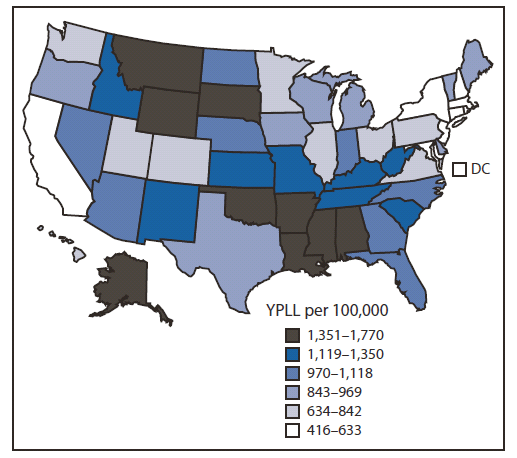
Alternate Text: The figure above shows annualized years of potential life lost (YPLL) attributed to unintentional injuries per 100,000 persons aged 0-19 years in the United States during 2000-2009. Thirty states had YPLL rates greater than or equal to the national YPLL rate of 890 per 100,000. The YPLL per 100,000 varied among the states, from 416 in Massachusetts to 1,770 in Mississippi. States with the highest YPLL rates were Mississippi (1,770), Alaska (1,592), South Dakota (1,573) and Wyoming (1,543). States with the lowest YPLL rates were Massachusetts (416), New Jersey (470), New York (484), and Connecticut (521). Syndicated Content Details:
Source URL: http://www.cdc.gov/mmwr/preview/mmwrhtml/mm6141a2.htm Source Agency: Centers for Disease Control and Prevention (CDC) Captured Date: 2016-05-23 22:14:27.0
|
|