
 |
BiologyThe natural ecology of malaria involves malaria parasites infecting successively two types of hosts: humans and female Anopheles mosquitoes. In humans, the parasites grow and multiply first in the liver cells and then in the red cells of the blood. In the blood, successive broods of parasites grow inside the red cells and destroy them, releasing daughter parasites ("merozoites") that continue the cycle by invading other red cells. The blood stage parasites are those that cause the symptoms of malaria. When certain forms of blood stage parasites ("gametocytes") are picked up by a female Anopheles mosquito during a blood meal, they start another, different cycle of growth and multiplication in the mosquito. After 10-18 days, the parasites are found (as "sporozoites") in the mosquito's salivary glands. When the Anopheles mosquito takes a blood meal on another human, the sporozoites are injected with the mosquito's saliva and start another human infection when they parasitize the liver cells. Thus the mosquito carries the disease from one human to another (acting as a "vector"). Differently from the human host, the mosquito vector does not suffer from the presence of the parasites. 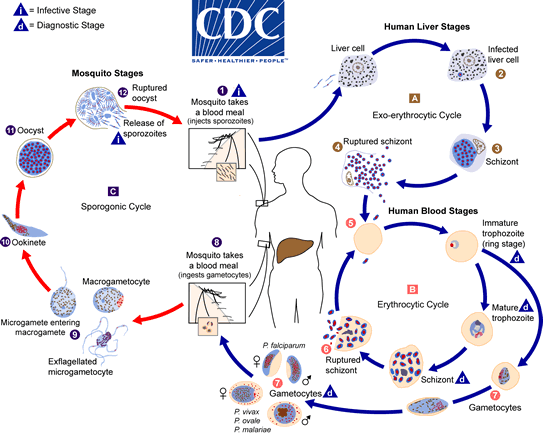
The malaria parasite life cycle involves two hosts. During a blood meal, a malaria-infected female Anopheles mosquito inoculates sporozoites into the human host The gametocytes, male (microgametocytes) and female (macrogametocytes), are ingested by an Anopheles mosquito during a blood meal More on: Anopheles Mosquitoes More on: Malaria Parasites Human Factors And MalariaBiologic characteristics and behavioral traits can influence an individual's risk of developing malaria and, on a larger scale, the intensity of transmission in a population. More on: Human Factors and Malaria Syndicated Content Details:
Source URL: http://www.cdc.gov/malaria/about/biology/index.html Source Agency: Centers for Disease Control and Prevention (CDC) Captured Date: 2016-05-23 22:24:20.0
|
 . Sporozoites infect liver cells
  and mature into schizonts
  , which rupture and release merozoites
  . (Of note, in P. vivax and P. ovale a dormant stage [hypnozoites] can persist in the liver and cause relapses by invading the bloodstream weeks, or even years later.) After this initial replication in the liver (exo-erythrocytic schizogony
  ), the parasites undergo asexual multiplication in the erythrocytes (erythrocytic schizogony
  ). Merozoites infect red blood cells
  . The ring stage trophozoites mature into schizonts, which rupture releasing merozoites . Some parasites differentiate into sexual erythrocytic stages (gametocytes)
  . Blood stage parasites are responsible for the clinical manifestations of the disease.
 . The parasites’ multiplication in the mosquito is known as the sporogonic cycle
  . While in the mosquito's stomach, the microgametes penetrate the macrogametes generating zygotes
  . The zygotes in turn become motile and elongated (ookinetes)
  which invade the midgut wall of the mosquito where they develop into oocysts
  . The oocysts grow, rupture, and release sporozoites
  , which make their way to the mosquito's salivary glands. Inoculation of the sporozoites
 |